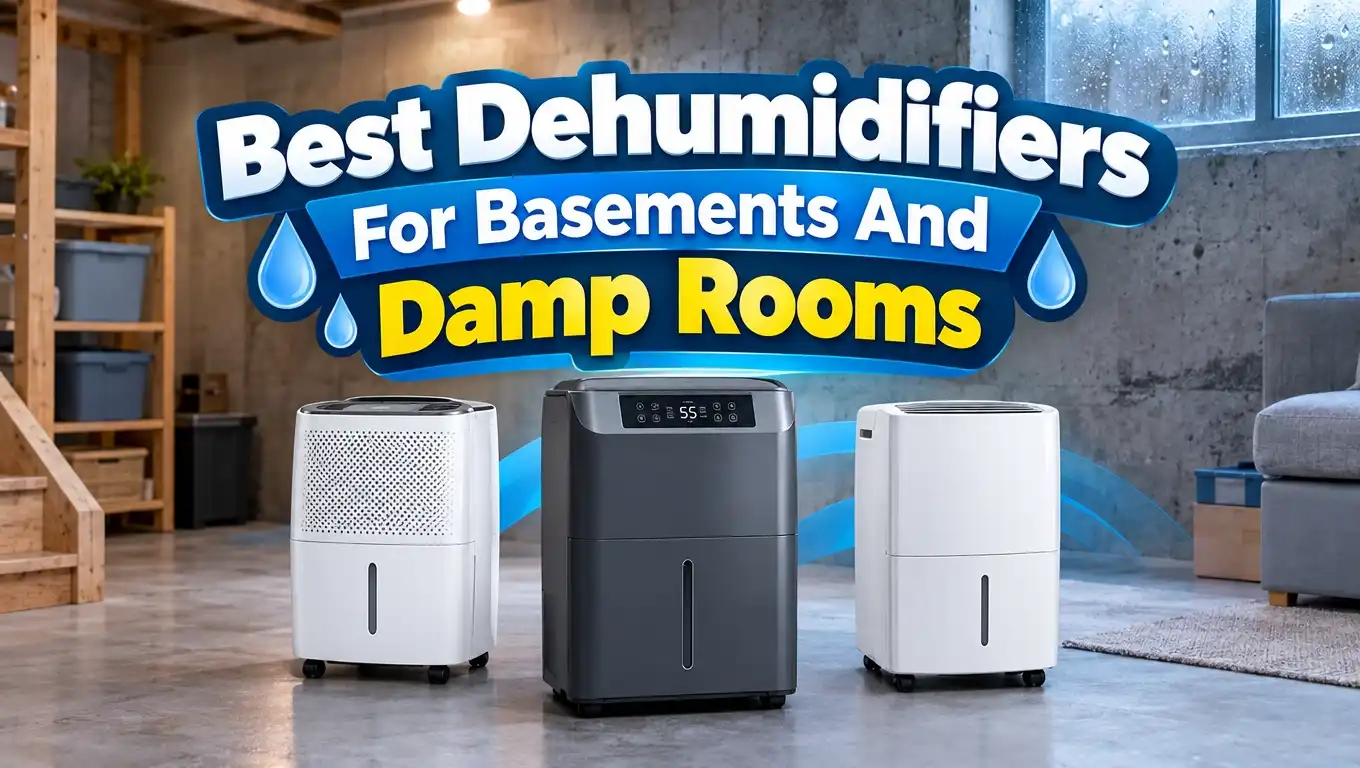
4 Best Dehumidifiers for Basements and Damp Rooms in 2026
Does your basement smell musty? Do you see water drops on the walls or feel sticky air when you walk downstairs? These are signs of too much humidity. Left alone, that moisture leads to mold, rust, warped wood, and ruined boxes.
A good dehumidifier fixes this problem fast. It pulls water out of the air and keeps your space fresh and dry. In this guide, we review 4 of the best dehumidifiers for basements and damp rooms in 2026. We cover features, pros, cons, and simple buying tips, so by the end you will know which one fits your home.
In a Nutshell
Here is a quick summary if you are short on time:
- AEOCKY 80 Pint (Best Overall Value): This model covers up to 5,500 sq ft and holds the Energy Star Most Efficient label. Its compact body fits tight basement corners. It is a strong pick for buyers who want big power at a fair price.
- KNKA 80 Pint (Best for Large Basements): This unit also removes up to 80 pints per day and covers up to 5,500 sq ft. It has a 1.45 gallon tank and comes with a long drain hose, so it suits big, open basements.
- hOmeLabs 50 Pint WiFi (Best Smart Pick for Huge Spaces): This unit is rated for up to 7,000 sq ft and has WiFi control and a Turbo mode. You can set humidity levels from your phone, which makes it ideal for busy homeowners.
- DREO 73 Pint Smart (Quietest Option): It runs at just 41 dB and uses Energy Star 6.0 tech. Its large 1.85 gallon tank lasts up to 15 hours. The app even tracks your power costs.
- Target Humidity: The EPA says to keep indoor humidity below 60 percent, and ideally between 30 and 50 percent, to stop mold growth.
- Smart Tip: Use continuous drainage in basements. It saves you from emptying the bucket every day.
Why Your Basement Needs a Dehumidifier
Basements sit below ground level. The soil around them holds moisture, and that moisture seeps through concrete walls and floors. Cool basement air also traps humidity more easily than warm upstairs air.
This creates the perfect home for mold and mildew. According to the EPA, indoor humidity should stay below 60 percent. The ideal range is between 30 and 50 percent. Most damp basements sit well above that, especially in summer.
High humidity causes many problems. It ruins stored items like books, clothes, and photos. It rusts tools and metal shelves. It warps wooden furniture and floors. It also attracts pests like dust mites, silverfish, and spiders.
Your health can suffer too. Mold spores can trigger allergies, asthma, and breathing problems. That musty smell is often the first warning sign that mold is growing somewhere you cannot see.
A dehumidifier solves this in a simple way. It draws in damp air, cools it over cold coils, and collects the water. Then it blows dry air back into the room. Over time, the whole space feels fresher and cleaner.
Damp rooms are not limited to basements. Laundry rooms, bathrooms, garages, and crawl spaces also trap moisture, and a good dehumidifier works in all of these spaces.
The best part is that modern units are smart, quiet, and energy efficient. Many can run all day without much attention from you. You set a humidity level, and the machine does the rest. Now let us look at the four best options for 2026.
1. AEOCKY 5500 Sq Ft Energy Star Most Efficient 80 Pint Dehumidifier

- 【ENERGY STAR 25 ≠ ENERGY STAR Most Efficient 2025】Don't fall for competitors' word games. With only 2.6% of ENERGY STAR models earning "Most Efficient 2025" title, these options are...
- 【True ENERGY STAR Most Efficient 2025 Compressor Dehumidifier for homes (5500 sq.ft)】80 pint/day in the humid Mid-summer (95℉, 95%RH); 56 pint/day in the warm, damp basement (86℉, 80%RH...
- 【Top-Rated Efficiency - Save More Energy】Breaking industry barriers, one of the first brands to achieve ENERGY STAR Most Efficient 2025. Compared to non-Energy Star inefficient products,RHEA...
Last update on 2026-10-18 / Affiliate links / Images from Amazon Product Advertising API
The AEOCKY 80 Pint dehumidifier is one of the most popular basement dehumidifiers on Amazon. AEOCKY even calls itself the number one dehumidifier brand on Amazon in the U.S. After looking at its features, it is easy to see why.
This unit removes up to 80 pints of moisture per day under humid conditions of 95°F and 90 percent humidity. It covers spaces up to 5,500 square feet, which makes it great for full basements and large open rooms.
It carries the Energy Star Most Efficient 2025 label. Only the most efficient products in a category earn that badge. In simple words, you get strong moisture removal while keeping your power bill under control.
The design is surprisingly compact. It measures about 14.45 inches deep and 8.66 inches wide, so it slides into corners and narrow spots without taking over your space.
The tank holds 1.45 gallons. You also get a drain hose for continuous drainage, which is a big plus for basements. Just connect the hose and run it to a floor drain.
Control is easy. The intelligent humidistat lets you set your target humidity. Once the room reaches that level, the compressor pauses to save energy. You also get a child lock, fan speed control, and a timer.
AEOCKY’s own testing shows noise levels around 47 to 48 dB, which is about as loud as a quiet conversation. Auto defrost also protects the coils when your basement gets cool.
Pros
- The Energy Star Most Efficient rating keeps running costs low.
- It covers up to 5,500 sq ft, which suits large basements.
- Its compact body fits tight corners and small spaces.
- The drain hose is included for continuous drainage.
- Child lock and timer add safety and convenience.
Cons
- It has no WiFi or app control.
- The 1.45 gallon tank fills quickly in very damp spaces.
- The 80 pint rating applies only at 95°F and 90 percent humidity.
2. KNKA Energy Star 5500 Sq Ft 80 Pint Dehumidifier

- 【𝐄𝐍𝐄𝐑𝐆𝐘 𝐒𝐓𝐀𝐑 𝐂𝐞𝐫𝐭𝐢𝐟𝐢𝐞𝐝 𝐟𝐨𝐫 𝐄𝐟𝐟𝐢𝐜𝐢𝐞𝐧𝐭 𝐏𝐞𝐫𝐟𝐨𝐫𝐦𝐚𝐧𝐜𝐞】Delivers consistent...
- ...
- 【𝐅𝐥𝐞𝐱𝐢𝐛𝐥𝐞 𝐃𝐫𝐚𝐢𝐧𝐚𝐠𝐞 𝐎𝐩𝐭𝐢𝐨𝐧𝐬 𝐟𝐨𝐫 𝐄𝐚𝐬𝐲 𝐔𝐬𝐞】Built-in 1.45 gal tank and 6.56 ft(2m) drain hose for...

Last update on 2026-10-18 / Affiliate links / Images from Amazon Product Advertising API
KNKA is a fast growing name in home air care. Its 80 pint basement dehumidifier is a direct rival to the AEOCKY, and many reviewers compare the two side by side.
This unit removes up to 80 pints of moisture per day in hot and humid conditions. It is rated for spaces up to 5,500 square feet, so it can handle large basements, big living rooms, and open floor plans.
The KNKA is Energy Star certified. That means it meets strict efficiency rules set by the U.S. government, and you can run it for long hours without a shocking electric bill.
The built in tank holds 1.45 gallons of water. KNKA also includes a 6.56 foot drain hose, which is longer than many rivals offer. This extra length gives you more freedom to place the unit far from a drain.
Like most modern units, it uses intelligent humidity control. You pick your target level, and the machine keeps the room there. When the tank fills, auto shutoff stops the unit to prevent spills.
This model also works well in bedrooms and bathrooms. It handles both big and small jobs, so you can move it from room to room as the seasons change.
YouTube reviewers often test this unit against AEOCKY and Deye models in “basement battle” videos. The KNKA holds its own in those tests. It is a solid, budget friendly workhorse for families who just want dry air without fuss.
Pros
- It removes up to 80 pints per day for heavy moisture jobs.
- Its 5,500 sq ft coverage suits large basements.
- The long 6.56 foot drain hose gives flexible placement.
- The Energy Star certification lowers power use.
- Auto shutoff prevents water spills.
Cons
- It has no smart app control.
- The tank size is average for an 80 pint unit.
- It is a newer listing, so it has fewer long term reviews.
3. hOmeLabs 7000 Sq Ft 50 Pint WiFi Dehumidifier

- Powerful Humidity Control – This Wi-Fi–enabled dehumidifier keeps spaces up to 7,000 sq ft comfortably dry and removes up to 50 pints per day at 80°F/60% RH (up to 120 pints at 95°F/90% RH).
- WiFi-Enabled Smart Functionality: Adjust your settings and control your dehumidifier remotely. With the cutting-edge WiFi feature, connect your dehumidifier to your home's network and manage your...
- Stylish for Modern Homes: We've designed with the modern consumer in mind, providing a sleek appearance, convenient wheels and handles, and a subdued fan that won't interfere with your quiet...
Last update on 2026-10-18 / Affiliate links / Images from Amazon Product Advertising API
hOmeLabs has sold dehumidifiers on Amazon for years. This model is a trusted favorite with a long track record. The newest version adds WiFi control, which makes it even more useful.
The unit removes up to 50 pints per day at 80°F and 60 percent humidity. Under extreme conditions of 95°F and 90 percent humidity, it pulls up to 120 pints per day. It covers spaces up to an impressive 7,000 square feet.
The WiFi smart control is the star feature. You can adjust humidity, set schedules, and change modes from your phone. It also works with voice assistants for hands free control, so you can check your basement from work or while on vacation.
Turbo mode boosts airflow from 188 CFM to 218 CFM for faster moisture removal. Use it after a heavy rain or a small leak.
The tank holds about 1.6 gallons. A full tank alert tells you when to empty it. For continuous drainage, you connect a drain hose. Check the listing to see whether the hose comes in your box, since some versions sell it separately.
Other handy features include a washable air filter, swivel wheels, side handles, and a cord storage bracket. Moving it between rooms is easy.
It is also Energy Star certified. One expert tester did find its power draw higher than average, though. Keep this in mind if you plan to run it all day.
Pros
- WiFi and voice control let you manage it from anywhere.
- Its 7,000 sq ft coverage is the largest on this list.
- Turbo mode dries rooms faster.
- The washable filter cuts replacement costs.
- Smooth wheels make moving it easy.
Cons
- The drain hose may be sold separately on some versions.
- Some tests show higher power use than rivals.
- It is bulkier than the AEOCKY.
4. DREO Energy Star Smart 73 Pint Dehumidifier

- 𝐏𝐨𝐰𝐞𝐫𝐟𝐮𝐥 𝟕𝟓-𝐏𝐢𝐧𝐭 𝐃𝐞𝐡𝐮𝐦𝐢𝐝𝐢𝐟𝐢𝐞𝐫 – 𝐅𝐚𝐬𝐭 𝐌𝐨𝐢𝐬𝐭𝐮𝐫𝐞 𝐑𝐞𝐦𝐨𝐯𝐚𝐥: Removes...
- 𝐄𝐍𝐄𝐑𝐆𝐘 𝐒𝐓𝐀𝐑 𝟐𝟎𝟐𝟓 𝐂𝐞𝐫𝐭𝐢𝐟𝐢𝐞𝐝 – 𝐒𝐚𝐯𝐞 𝐄𝐧𝐞𝐫𝐠𝐲 & 𝐋𝐨𝐰𝐞𝐫 𝐁𝐢𝐥𝐥𝐬: Uses 30% less...
- ...
Last update on 2026-10-18 / Affiliate links / Images from Amazon Product Advertising API
DREO is known for sleek, quiet home appliances. Its 73 pint smart dehumidifier, also called the DREO 733S, continues that trend. It is the quietest dehumidifier on our list.
This model removes up to 73 pints per day at 95°F and 90 percent humidity. DREO says it can lower room humidity by up to 25 percent per hour, and it covers spaces up to 2,000 square feet.
Noise is where the DREO shines. It runs at just 41 dB, which is close to the hum of a quiet library. You can use it in bedrooms, offices, and finished basements without hearing it much.
It is Energy Star 6.0 certified. DREO says it uses 30 percent less energy than standard models and could save you up to $292 per year on electricity.
The tank is large at 7 liters, or 1.85 gallons. That gives you up to 15 hours of runtime before you need to empty it. You can also attach the included drain hose for nonstop drainage.
The DREO app adds smart control. You can monitor real time energy use, track power costs, and adjust humidity remotely. Few dehumidifiers offer cost tracking like this.
Other features include 3 fan speeds, a 24 hour timer, child lock, auto defrost, and water level detection. A soft humidity light shows room status without lighting up the whole room at night.
Pros
- At 41 dB, it is very quiet and works in bedrooms.
- Energy Star 6.0 tech saves up to 30 percent on power.
- The large 1.85 gallon tank runs up to 15 hours.
- The app tracks energy use and costs.
- The drain hose comes included.
Cons
- Coverage of 2,000 sq ft is smaller than its rivals.
- It is less suited to huge, open basements.
- The compressor needs a 3 minute warm up after restarting.
Quick Comparison of All 4 Dehumidifiers
Comparing four products can feel confusing. This section puts them side by side in plain words, so you can spot the right one fast.
The AEOCKY 80 Pint gives you the best balance of power, efficiency, and size. It covers 5,500 sq ft and wears the Energy Star Most Efficient badge. It is the best all around pick for most basements.
The KNKA 80 Pint matches the AEOCKY in power and coverage. Its long 6.56 foot drain hose is a small but useful perk. Choose it if your floor drain sits far from where you want the unit.
The hOmeLabs 50 Pint WiFi covers the most space at 7,000 sq ft. It is the best choice if you want phone and voice control. Its Turbo mode helps after floods or storms.
The DREO 73 Pint is the quietest at 41 dB. It has the biggest tank at 1.85 gallons and the best app, with energy cost tracking. It suits finished basements, bedrooms, and medium sized damp rooms.
Here is a simple way to decide. If you want value, pick the AEOCKY. If you want long hose reach, pick the KNKA. If you want smart control for a huge space, pick the hOmeLabs. If you want quiet operation, pick the DREO.
All four units offer auto humidity control. All four support continuous drainage and come from brands with strong Amazon ratings. You really cannot go wrong with any of them.
Your final choice depends on your space size, your noise tolerance, and whether you care about smart features. Think about how you will use the unit day to day. That answer usually points you to the right model.
How to Read Dehumidifier Pint Ratings the Right Way
Pint ratings confuse many buyers. A 50 pint unit and an 80 pint unit may perform closer than you think. Here is why.
In June 2019, the U.S. Department of Energy changed its testing rules. Old tests ran at 80°F and 60 percent humidity. New tests run at 65°F and 60 percent humidity, which is closer to real basement conditions.
Cooler air holds less water, so units tested the new way show lower pint numbers. A unit rated at 70 pints under the old system might show about 50 pints under the new one, even though the machine itself is the same.
Many brands now list a “max” number tested at 95°F and 90 percent humidity. Those numbers look much bigger. For example, the hOmeLabs lists 50 pints at standard conditions but 120 pints at max conditions.
So how should you compare? Always check the test conditions next to the pint number. Compare units only when they are tested the same way.
In our list, the AEOCKY, KNKA, and DREO list ratings at 95°F and 90 percent humidity. The hOmeLabs gives both standard and max ratings. This is why its 50 pint number looks small next to the others.
A higher pint rating means faster drying in very wet conditions. For most basements, any of these four units has more than enough power.
Do not chase the biggest number alone. Look at coverage area, efficiency, and noise too. A balanced unit often serves you better than the one with the highest pint claim.
How to Choose the Right Size for Your Space
Picking the right size is the most important buying step. A unit that is too small runs nonstop and never catches up. A unit that is too big wastes money.
Start by measuring your space. Multiply length by width to get square feet. A 30 by 40 foot basement equals 1,200 square feet.
Next, judge how damp the space feels. Here is a simple guide. A slightly damp space smells musty only in humid weather. A very damp space always smells musty and may show damp spots. A wet space has water on the walls or floor.
For small or slightly damp rooms under 2,000 square feet, the DREO 73 Pint works well. It is quiet and efficient, so it suits bedrooms and finished basements.
For medium to large basements up to 5,500 square feet, the AEOCKY or KNKA are great fits. Their 80 pint power handles heavy summer humidity with ease.
For very large homes or open basements over 5,000 square feet, the hOmeLabs stands out with its 7,000 square foot rating.
Remember that coverage claims assume good airflow. Walls, doors, and stored boxes block air movement. If your basement is split into many rooms, pick a larger unit than your square footage suggests, or use two smaller units.
Climate matters too. Homes in humid areas like the Southeast or Gulf Coast need more power than homes in dry regions. When in doubt, size up. A bigger unit reaches your target faster, then rests to save energy.
Drainage Options: Bucket vs Continuous Hose
Every dehumidifier collects water. You have two ways to get rid of it: empty the bucket by hand, or use a drain hose.
The bucket method is simple. The unit fills its tank and shuts off when full. You carry the tank to a sink and dump it. It works fine in rooms with light moisture.
But basements are different. A damp basement can fill a tank several times a day in summer, and emptying it that often gets old fast. If you forget, the unit stops working and humidity climbs again.
That is why continuous drainage is so useful. You attach a hose to the drain port, and water flows out by gravity into a floor drain, sump pit, or utility sink. You never touch the tank.
All four units on our list support continuous drainage. The KNKA includes a long 6.56 foot hose. The AEOCKY and DREO also include hoses. Some hOmeLabs versions sell the hose separately, so check before you buy.
Gravity drainage has one rule. The drain must sit lower than the hose outlet. Water cannot flow uphill. If your drain is higher, you need a model with a built in pump instead.
Keep the hose straight and free of kinks, since bends trap water and cause backups. Check the hose every few weeks for clogs or leaks.
Tank size still matters when you use the bucket. The DREO has the biggest tank at 1.85 gallons, followed by the hOmeLabs at 1.6 gallons. The AEOCKY and KNKA each hold 1.45 gallons.
Best Place to Put a Dehumidifier in Your Basement
Where you place your dehumidifier affects how well it works. Even the best unit struggles in a bad spot.
First, put it near the source of moisture. If one corner always feels damp, start there. Laundry areas and spots near the sump pump are common trouble zones.
Second, keep it away from walls and furniture. Most makers suggest at least 12 inches of open space around the unit. Air needs to flow freely in and out.
Third, place it near a floor drain if you plan to use continuous drainage. This keeps the hose short and the water flowing smoothly.
Fourth, put it on a flat and level surface. A tilted unit may leak or trigger the full tank sensor by mistake.
Fifth, keep doors and windows closed while it runs. Open windows let fresh humid air in, and the unit then works harder for no reason.
Avoid placing it right next to a clothes dryer. The dryer blows warm, moist air that confuses the humidity sensor. DREO’s own guide warns about this. Make sure your dryer vents outside.
In a large basement, a central spot often works best because it spreads dry air evenly. You can also move the unit around for a few days to find the sweet spot.
Finally, use a separate hygrometer to check humidity in different corners. This simple gadget costs very little and shows whether your unit reaches every part of the space.
Energy Costs and Why Energy Star Matters
Dehumidifiers often run for many hours a day, so energy use adds up quickly. Choosing an efficient model saves you real money over time.
The Energy Star label means a product meets strict efficiency rules from the U.S. government. Energy Star dehumidifiers remove the same amount of moisture using less electricity than standard models.
The AEOCKY goes a step further with the Energy Star Most Efficient 2025 label. This badge marks the top performers in each category, so it is a sign of excellent efficiency.
The DREO uses Energy Star 6.0 tech. DREO says it uses about 30 percent less energy than standard models and can save up to $292 per year. Its app also shows real time power use and costs, so you can see exactly what you spend.
The KNKA and hOmeLabs are also Energy Star certified. Keep in mind that one independent tester found the hOmeLabs drew more watts than average in its tests.
You can lower costs further with smart habits. Set your target humidity to 45 or 50 percent. Going lower than needed makes the unit run longer for little benefit.
Use the auto mode. It lets the compressor rest once the room hits your target, which cuts power use a lot.
Seal obvious leaks too. Fix cracks in walls, add weather stripping, and keep gutters clean. Less moisture coming in means less work for your machine. A smart setup pays off with a drier home and a smaller power bill.
Care and Maintenance Tips for Long Life
A dehumidifier is a long term investment. Simple care keeps it running well for years and protects your money.
Clean the air filter every two to four weeks. A dirty filter blocks airflow and makes the unit work harder. Most filters, including the one on the hOmeLabs, are washable. Rinse it with warm water, let it dry, and slide it back in.
Empty and wash the tank often if you use the bucket. Standing water can grow mold and bacteria. Wash it with mild soap and water once a week.
Check the drain hose if you use continuous drainage. Look for kinks, clogs, or algae buildup, and flush it with water every month or two.
Keep the coils clean as well. Dust on the coils lowers performance. Unplug the unit and gently vacuum the coils with a soft brush once or twice a year.
Respect the compressor rest time. Many units, including the DREO, wait about 3 minutes before restarting the compressor. This protects the motor. Do not keep switching the unit on and off.
Watch for frost. All four units have auto defrost, which melts ice on cold coils. Still, avoid running them in rooms colder than about 41°F, since most compressor units lose efficiency at low temperatures.
Store it properly in the off season. Drain all the water, dry the tank, clean the filter, and wrap the cord. Keep it upright in a dry place.
With these simple steps, your dehumidifier will stay quiet, efficient, and effective for many seasons.
Final Verdict: Which Dehumidifier Should You Buy?
All four dehumidifiers on this list are strong choices for basements and damp rooms. Each one shines in a different way.
The AEOCKY 80 Pint is our top overall pick. It combines 5,500 square foot coverage, the Energy Star Most Efficient label, and a compact body. It gives you the most value for most homes.
The KNKA 80 Pint is a close second. It matches the AEOCKY in power and coverage. Its long drain hose makes it the better pick when your drain sits far away.
The hOmeLabs 50 Pint WiFi is the best smart choice for huge spaces. With 7,000 square foot coverage, phone control, and Turbo mode, it suits large homes and busy owners.
The DREO 73 Pint is the quietest and smartest option for medium spaces. Its 41 dB noise level, large tank, and energy tracking app make it perfect for finished basements and bedrooms.
Think about your needs before you buy. Measure your space and note how damp it gets. Decide whether noise or smart control matters to you. Then match those needs to the right model.
Whatever you choose, aim for 30 to 50 percent humidity. Use continuous drainage in basements, and keep your filter clean.
A dry basement is a healthier basement. Your stored items stay safe, your air smells fresh, and mold stays away. Pick the dehumidifier that fits your home, plug it in, and enjoy the difference.
Frequently Asked Questions
What is the ideal humidity level for a basement?
The EPA says indoor humidity should stay below 60 percent. The ideal range is between 30 and 50 percent. Most homeowners set their basement dehumidifier to about 45 or 50 percent.
How long should a dehumidifier run in a basement each day?
It depends on how damp your space is. Most basement units run 12 to 24 hours a day in humid seasons. With auto mode, the unit stops once it reaches your target humidity.
Can I run a dehumidifier all day and night?
Yes. Modern dehumidifiers are built to run continuously. Use a drain hose so the tank never fills and shuts the unit off. Auto humidity control also helps save energy.
Which dehumidifier on this list is the quietest?
The DREO 73 Pint is the quietest at about 41 dB. That makes it a great choice for bedrooms, offices, and finished basements.
Do I need a dehumidifier with a pump?
You only need a pump if your drain sits higher than the unit’s drain port. If you have a floor drain or a sump pit at a lower level, gravity drainage works fine.
Will a dehumidifier get rid of mold?
A dehumidifier stops new mold from growing by drying the air. It does not remove existing mold. Clean visible mold first, then use the dehumidifier to keep it from coming back.
What size dehumidifier do I need for a 2,000 square foot basement?
A unit rated for at least 2,000 square feet works for moderate dampness. The DREO covers that size well. For very damp spaces, choose a larger model like the AEOCKY or KNKA.
How much does it cost to run a basement dehumidifier?
Costs depend on your electric rate, the model, and how long it runs. Energy Star models cost less to run. The DREO app even tracks your real power costs so you can see your spending.

Dillip started Before You Checkout after one too many disappointing online purchases, and now spends his time researching products across home, tech, fitness, and everyday essentials. He writes straightforward reviews and how-to guides for people who want a clear answer, not a sales pitch.