
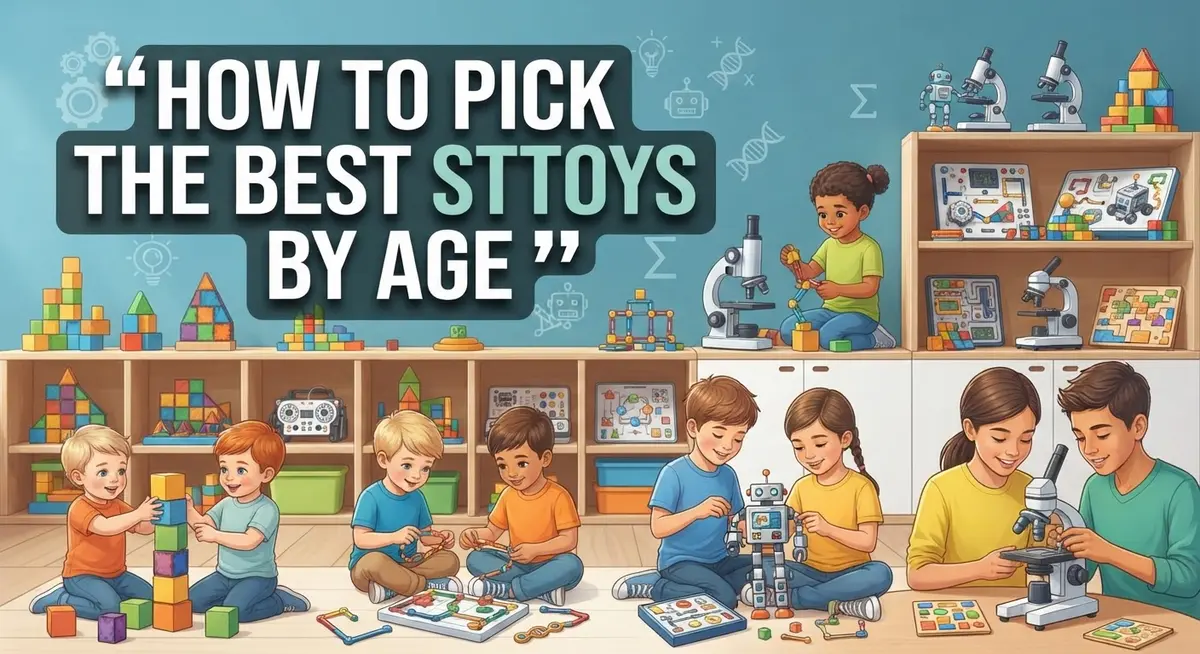
How to Pick the Best STEM Toys by Age: A Parent’s Guide
Picking the right STEM toy can feel like a puzzle. You want something fun. You also want something that actually teaches your child new skills.
The truth is simple. Age matters more than hype. A toy that’s too easy gets ignored. A toy that’s too hard causes frustration.
The best STEM toys grow with your child. They offer multiple ways to play. They keep little hands busy for weeks, not just days.
Many parents make the same mistakes. They pick toys based on trends. They ignore developmental stages. They choose items with only one function.
This guide fixes that problem. We break down STEM toy selection by age group. You will learn what skills each stage needs.
We also share the key questions every parent should ask before buying. Is it age appropriate? Does it teach real concepts? Will it hold attention long term?
Our goal is simple. Help you choose toys that build real thinking skills. Toys that spark curiosity today and support learning for years to come.
In a Nutshell
Here is a quick summary to keep in mind:
-
Match the toy to the child’s age and skills. Always check the packaging for age guidance. The right fit builds confidence and keeps learning fun.
-
Look for multiple play modes. A toy with several ways to play stays interesting much longer. This keeps kids curious instead of bored after a week.
-
Pick toys that grow with your child. The best options last one to two years or more. This gives you real value for your money.
-
Choose screen free options when possible. Hands on toys build focus and creativity. They also teach genuine STEM skills instead of passive watching.
-
Support real milestones. For babies and toddlers, toys should back real developmental progress. This means sensory, motor, or thinking skills.
-
Ask the right questions before buying. Is it age appropriate? Does it teach something real? Will your child still love it in a month? These simple checks make picking easier and smarter.
What Are STEM Toys and Why They Matter
STEM stands for Science, Technology, Engineering, and Mathematics. STEM toys are tools that teach these subjects through hands-on play and exploration.
These toys matter because they build critical thinking skills early. When children play with STEM toys, they learn to ask questions, test ideas, and solve problems. This foundation supports success in school and beyond.
STEM toys encourage creativity alongside learning. A child building a structure uses math, physics, and imagination all at once. They discover cause and effect naturally. They learn persistence when something doesn’t work the first time.
The brain develops rapidly during childhood. STEM toys support this growth by engaging multiple thinking areas at once. Children learn to break big problems into smaller steps. They practice patience and experimentation.
Real learning happens through play. Unlike passive entertainment, STEM toys require active participation. Children make decisions, test outcomes, and adjust their approach. This process builds confidence in their own abilities.
STEM toys also prepare children for future opportunities. Many careers require these foundational skills. Starting early gives children an advantage and helps them see learning as fun rather than a chore.
The best STEM toys teach genuine concepts, not just entertainment disguised as education. A toy that simply lights up and makes noise differs from one that teaches patterns, building, or problem-solving. The difference matters for real development.
Age-appropriate selection is crucial. A toy too advanced frustrates children. A toy too simple bores them quickly. The sweet spot is a toy that challenges them just slightly beyond their current skills. This keeps engagement high and learning active.
Understanding Developmental Stages and Play Needs
Understanding your child’s developmental stage helps you pick STEM toys that truly work. Children learn differently at each age, and a toy that’s too advanced frustrates them. A toy that’s too simple bores them quickly.
Babies and toddlers (ages 0–2) need toys that support motor skills and sensory exploration. They benefit from toys that respond to their actions, like cause and effect toys. At this stage, safety and durability matter most.
Preschoolers (ages 3–5) start recognizing patterns and solving simple problems. They enjoy toys with building components, basic sorting activities, and open ended play options. Their attention span grows, so toys with multiple ways to play keep them engaged longer.
Early elementary kids (ages 6–8) develop stronger logic and reasoning abilities. They can follow more complex instructions and enjoy challenges that require planning. Toys combining building, coding basics, and hands on experiments work well here.
Older elementary students (ages 9–11) think more abstractly and enjoy competitive or collaborative play. They tackle multi step projects and appreciate toys teaching real science or engineering concepts.
The key is matching difficulty to current skills, not jumping ahead. A toy slightly above your child’s current level encourages growth without frustration. Check packaging labels for age recommendations, but also know your individual child. Some kids develop faster in certain areas than others.
Watch how your child plays with current toys. Do they solve problems independently? Do they enjoy hands on activities? These observations guide better selections. Play needs shift constantly, so reassess every few months as your child grows and learns new skills.
STEM Toy Guide for Babies and Toddlers (0-2 Years)
Babies and toddlers from birth to age two learn through their senses and physical movements. Their brains develop fastest during these early months, so toy selection matters greatly. The right STEM toys support this natural learning without overwhelming them.
At this stage, babies explore by touching, mouthing, and shaking objects. They begin grasping around three months and develop hand eye coordination by six months. Toys should be soft, safe, and easy to hold. Look for items with different textures, sounds, and colors that respond to your baby’s actions.
Toddlers (ages 12 to 24 months) start stacking, sorting, and moving objects intentionally. They enjoy cause and effect play, where their action creates a result. Simple building blocks, shape sorters, and rolling toys work well at this stage.
When selecting toys for this age group, check that all pieces are large enough to prevent choking hazards. Toys should have no sharp edges or small parts that detach easily. Verify the age recommendation on packaging matches your child’s current abilities.
Look for toys with multiple ways to play. A toy that rolls, stacks, and makes sounds stays interesting longer than one with a single function. The best options keep your baby engaged for weeks or months, not just days.
Choose screen free options exclusively. Babies learn through physical interaction, not screens. Toys that encourage reaching, grasping, and moving build real motor skills your child needs.
Finally, rotate toys every few weeks. Your baby will rediscover “old” toys with fresh interest, and you extend the life of each item without buying constantly.
STEM Toy Guide for Preschoolers (3-5 Years)
Preschoolers aged 3 to 5 years are natural explorers who love asking “why” and “how.” At this stage, your child’s brain is ready for toys that introduce basic STEM concepts through hands on play.
Pattern recognition becomes a major milestone during these years. Your child can now notice colors, shapes, and sequences. Look for toys that let them sort objects by size, color, or type. These activities build foundational math skills without feeling like lessons.
Simple building and construction toys work wonderfully at this age. Your child can stack blocks, connect pieces, and create structures. These toys teach cause and effect: when I place this block here, what happens? Your child learns that their actions create results.
Problem solving starts developing around age 4. Choose toys where your child must figure out how pieces fit together or how to complete a simple task. Puzzles with large pieces, shape sorters, and basic coding toys (that use physical buttons instead of screens) all work well.
Preschoolers also benefit from toys that combine multiple play modes. A toy that works as a building set, a sorting game, and a counting tool keeps your child engaged longer than a single purpose toy.
Safety remains important at this age. Check that toys have no small parts your child could swallow. Verify the age recommendation on packaging matches your child’s abilities.
The best STEM toys for preschoolers feel like play, not school. Your child should want to return to the toy week after week, discovering something new each time. This repeated engagement builds genuine learning and confidence.
STEM Toy Guide for School-Age Kids (6-9 Years)
School-age kids from 6 to 9 years old are ready for more complex STEM challenges. At this stage, children develop stronger logic skills and can follow multi-step instructions. They also enjoy working independently or with peers.
Your child’s brain is now capable of abstract thinking. This means toys don’t need to be as colorful or immediately obvious in their function. Kids this age can understand cause and effect across longer sequences. They also appreciate toys that let them build, test, and rebuild.
Look for toys that offer multiple ways to play. A single toy should work for different activities over time. For example, a building system might start as simple stacking, then progress to following blueprints, and later become freestyle design. This flexibility keeps kids engaged for years instead of weeks.
Screen-free options remain important at this age. Your child benefits most from hands-on experimentation. They learn by doing, testing ideas, and sometimes failing. This trial-and-error process builds real problem-solving skills.
Check the age range on packaging carefully. “Ages 6+” might mean the toy works best around age 7 or 8. A toy that’s too easy gets boring quickly. A toy that’s too hard causes frustration. Aim for something that challenges your child without overwhelming them.
Consider toys that teach real concepts. Look for items that involve coding basics, engineering principles, or scientific methods. These toys should make your child think and plan, not just follow one simple pattern.
Finally, think about longevity. The best STEM toys grow with your child. They remain useful and interesting from age 6 all the way through age 9 or beyond.
STEM Toy Guide for Tweens and Teens (10+ Years)
Tweens and teens aged 10 and up are ready for serious STEM challenges. At this stage, your child thinks abstractly and enjoys solving real world problems. They want toys that feel less like “toys” and more like actual projects.
Look for items that teach genuine engineering, coding, or scientific concepts. Your tween should be able to understand cause and effect relationships. They can follow multi step instructions without constant adult help. This independence matters because it builds confidence.
Multiple play modes become even more critical now. A toy your tween can use in five different ways will stay interesting for months. A toy with only one function gets boring in a week. Ask yourself: can this toy be used in new ways as my child’s skills improve?
Consider toys that grow with your child. The best options work for tweens today and remain engaging through the teen years. This longevity saves money and reduces waste.
Screen free options still matter at this age, though some interactive digital elements can add value if they teach real skills. Avoid toys that are mostly entertainment dressed up as education.
Verify age appropriateness on the packaging. Some toys marked for ages 10+ actually work better at 12 or 13. Read the description carefully. Does it match your child’s current abilities? A toy too easy becomes frustrating. A toy too hard also frustrates and gets abandoned.
Think about your child’s interests too. A tween fascinated by robotics needs different toys than one interested in chemistry or architecture. Matching the toy to their curiosity keeps them engaged longer and deepens their love of learning.
Step-by-Step: How to Evaluate Any STEM Toy
Evaluating a STEM toy before buying it takes just a few minutes. Start by checking the age range printed on the packaging. This number tells you whether the toy matches your child’s current skills and safety needs.
Next, read the toy description carefully. Look for toys that offer multiple ways to play. A toy with one single function gets boring fast. Instead, choose items your child can use in different ways as they grow and learn.
Ask yourself this key question: Does this toy teach real STEM concepts? Entertainment value matters, but genuine learning outcomes matter more. The toy should help your child practice problem solving, build spatial awareness, or understand basic science principles. Avoid toys that just flash lights or make noise without teaching anything.
Consider how long your child will actually use it. Will the toy stay interesting for several months, or just a few weeks? The best picks work for 1 to 2 years or longer as your child’s abilities improve.
Check for screen-free options when possible. Hands-on play builds stronger learning than passive screen time. If a toy includes digital elements, make sure those elements teach real content, not just provide entertainment.
Finally, think about your specific child. Does the toy match their interests? A child who loves building will engage differently than one who loves nature exploration. The perfect STEM toy combines age appropriateness, genuine learning value, multiple play modes, and personal interest. These factors together predict whether your child will actually use and enjoy the toy long term.
Common Mistakes to Avoid When Choosing STEM Toys
Parents often make predictable mistakes when shopping for STEM toys. Understanding these errors helps you make smarter choices for your child.
The biggest mistake is buying toys that don’t match your child’s actual development level. A toy marked for ages 5 and up might frustrate a 4 year old who isn’t ready yet. Conversely, a toy designed for 6 year olds may bore an advanced 5 year old. Always check the packaging and honestly assess where your child stands right now.
Choosing toys with limited play options is another common error. A toy that does only one thing will lose your child’s interest within days. Your child needs toys offering multiple ways to engage. Can they build different structures? Solve problems in various ways? Experiment with new combinations? If the answer is no, skip it.
Many parents prioritize toy hype over actual learning value. Just because everyone talks about a toy doesn’t mean it teaches real STEM concepts. Some toys look educational but mainly entertain. Ask yourself: Does this toy teach genuine science, technology, engineering, or math skills? Or is it just flashy fun?
Overlooking longevity is also problematic. A toy your child uses for one week wastes money and resources. Look for items that grow with your child across multiple years. Can they return to it as they develop new skills?
Finally, avoid toys that feel like school rather than play. Young learners need to enjoy the experience. The best STEM toys make learning feel natural and exciting, not like homework. When a toy balances education with genuine fun, your child will stay engaged much longer.
Final Thoughts
Picking the right STEM toy does not need to feel complicated. Simple steps make a big difference. Focus on your child’s actual age and skill level first.
Always check the packaging for age guidance. This gives you a solid starting point. But remember, every child grows at their own pace.
Multiple play modes matter more than flashy features. A toy that offers different ways to play keeps kids engaged longer. This means better value and better learning over time.
Screen free options often build stronger skills. Hands on play helps children think, problem solve, and create. Digital elements can help too, but only if they teach something real.
Ask yourself if the toy teaches a genuine STEM concept. Entertainment alone will not build lasting skills. Look for toys that mix fun with real learning.
Think about how long the toy will hold your child’s interest. Toys that grow with your child offer better long term value. This saves money and keeps learning consistent.
Avoid common mistakes like buying toys that do not match your child’s current ability. This can lead to frustration or boredom. Matching the toy to the child is key.
Every child is different, so consider their personal interests too. A toy that connects to what they already love will spark more curiosity. This makes learning feel natural, not forced.
In the end, the best STEM toy supports growth, curiosity, and confidence. It should feel like play, not a lesson. With these simple checks, you can pick toys that truly help your child learn and grow.
Frequently Asked Questions
What’s the difference between a STEM toy and regular educational toy?
STEM toys focus on science, technology, engineering, and math through hands-on exploration. A regular educational toy might teach letters or colors passively. STEM toys require your child to build, experiment, test ideas, and solve problems. They encourage active thinking rather than just watching or listening.
How do I know if a toy will keep my child interested for more than a week?
Look for toys with multiple play modes. A toy that does one thing gets boring fast. Choose options your child can use in different ways as they grow. Read reviews from parents and educators who tested toys over time. Ask yourself if the toy grows with your child’s skills.
Should I avoid all screen-based STEM toys?
Screen free options build stronger hands-on skills for most ages. However, some interactive digital elements can add value if they teach real concepts, not just entertainment. Balance matters. If you choose a screen based option, make sure it involves actual problem solving, not passive watching.
My child is advanced for their age. Should I buy toys marked for older kids?
Yes, but carefully. Toys marked for ages 10+ sometimes work better at 12 or 13. Check the actual complexity, not just the age label. Pick toys that challenge your child without causing frustration. A toy that’s too hard gets abandoned. One that’s slightly challenging keeps them engaged.
How do I avoid buying toys that feel like school instead of play?
The best STEM toys feel like games or adventures. They don’t require worksheets or feel like homework. Your child should want to play with them, not feel forced. If a toy feels like a lesson, keep looking.

Dillip started Before You Checkout after one too many disappointing online purchases, and now spends his time researching products across home, tech, fitness, and everyday essentials. He writes straightforward reviews and how-to guides for people who want a clear answer, not a sales pitch.


